10 June 2015

BYOD... Where to Next...

Thanks to my wonderful PLN on Twitter, I was able to attend a webinair this evening about Rolling Out Chromebooks.
I still enjoy being able to tap into others' experiences and piecing together what is right for us by reflecting on others' journeys and am always grateful for the free sharing that takes place.
These were my main take-aways from Blake's (@BlakeSeufert) session...
Firstly, (it's a given) that implementation does not lead to effective classroom practice. This becomes another prong to the leadership role. The three pillars to adoption include change management of the following:base level of access including wifi, devices, etc. No point moving ahead until the system is robust.professional development: external experts creating confidence: teachers have steps in place, realistic timelines etc. to get things fixed. (prevent people being jaded and burnt by the potential transformation)The web is an integral component to education now. It is a key tool to acquiring knowledge. The device is the tool; a paintbrush or a magnifying glass. Chromebooks are unique as a device=boot time <5 seconds (2-3 with new CBs from power on to onto the web) Really Fast7.5 hours per battery security of the device: hands off… self updates including security and apps, protection against malware, no third partyapps: a shortcut to a website or a link - look for pixlr, audio, WeVideo  and WeVideo Next which you can work off line with USB with, edit, etc and then upload.You can pin apps to the task bar.Need to explore a white glove service for student’s chromebooks My next steps:

  • Privacy agreement is vital… 
  • Attend the Communicating change and school branding webinar.
  • Ensure that single sign in providers can navigate to chrome
  • Allow kids access to apps - freedom to innovate
  • Introduce emails but make sure they are locked internally
  • survey staff - gage their interest/ support b4 introducing

I was affirmed by Blake's reference to the fact that "holistic students need a range of devices and platforms."

9 June 2015

The New Little School Down South....

Tonight I had to lead one of those nuts and bolts sessions that ensured we had a collective vision and practice that enables our shared vision.

I decided to start it with a reminder that the journey has gone before each of us that put their hand up for this to the very visionary locals that had  a vision for our school...


31 May 2015

Engaging the team in Professional Learning and Dialogue

Just by making use of Twitter and a simple hashtag, professional learning took on a whole new perspective this past week. It was great to see people sharing their thoughts and opinions in the back channel!

30 May 2015

Big Week - New Phase

My thinking was challenged on so many different levels this week after several sessions/ discussions with Julia Aitken, the leadership team and the teaching team. It was one of those weeks that was absolutely draining due the depth of thought and emotional energy spent. I found it completely worthwhile and the week generated many 'new thinks' for me - each of which I will need to blog about separately.

Pixabay by John Hain
The first is another perhaps deeper reflection about collaboration. This has been an on-going area of discussion and thought for me. I have found that while we all value the concept of collaboration and believe it is a skill that our children need to develop; we don't necessarily have a collective understanding of collaboration.  

Effective collaboration requires dialogue about previously unforeseen opportunity and possibilities. High quality collaboration requires teaming which in turn requires a psychologically safe environment to speak up. That means that to move from a group to a team we need to ensure that the environment is one of high trust. The people have a shared responsibility to achieve such an environment. Each of us need to be reflective and totally prepared to absorb others’ ideas and build on them. Which of course means that people need to be open and share their ideas and always prepared to have their ideas morphed and re-shaped by others. It is this kind of collaborative environment that will lead to innovative practice.

Pixabay by HebiPics 
All of this can only be achieved with a clear, collective vision. Julia suggested that schools are abominable at visioning! They constantly seem to come up with a statement and then park it or paint it on the wall at the very most. This resonated for me. It is all too easy to lose sight of the big picture vision when our days can be dominated by the micro administrative stuff.  

"Without vision, there’s paralysis" (my favourite quote from Julia). "The challenge is to build a common shared vision and that is only done through conversations." 

It is about ownership and alignment. 

The vision answers the ‘Why’ question. This will lead to shared understandings and a collective agreement. Julia suggested that schools have a lot to learn from businesses when it comes to developing a vision statement. She shared great examples in her own words such as Nike (to make everyone an athlete), Pepsi (to beat Coca Cola) and Disneyland. - (to make people happy).

flickr
To ensure our vision statement/ purpose is effective, we need to perhaps consider the following:
  • is it cognitively portable? Can all stakeholders recall it easily? 
  • does it challenge and inspire the team to strive to reach a high but achievable goal?
  • is it fixed? The principles and practices may change over time but the purpose of what we do on a daily basis remains the same. 


26 May 2015

Building Learners' Capacities


The Development of our Learners - what toolkit, competencies will they have? What will they have that makes them unique to children from other parts of the country?


We live in an amazing laboratory - serve the learner and the environment as opposed to contain learning inside the classroom. We have the opportunity to design a curriculum that is unique to our environment.


If our children thrive in this environment the outcomes include:


  • lifelong learners
  • relating to self/ others
  • adaptability
  • resourceful
  • Polarity Map
    resilient
  • risk takers
  • curious
  • compassionate
  • ability to persist
  • courage
  • connectedness to what has come before
  • contributing
  • voice: leading learning
  • innate love of learning
  • empowered
  • self regulating/ self managing
  • knowledgeable and resourceful
  • moral and ethical
  • entrepreneurial - kiwi ingenuity, initiative, innovative
  • Contented


To make it real this list needs to be smaller.


Implicit responsibility for educators to lead learners through their learning. Scaffolding is need to support our children to achieve these characteristics. We need to take this back to our beliefs and principles.


The 5 key competencies appear to underpin what we are talking about. ie, resilience is a part of managing self, growth mindset culminates all of the competencies. Therefor what makes us unique is the context that we operate within. The competencies are the essence of the curriculum so therefore, what does that look like in the culture of our school. 

Rhetorical question: are we delivering a 21st Century curriculum or is it just a 1995 add on? Competencies are like dispositions, they are a set of behaviours rather than skills. They wire the learner with competencies to help them to achieve with core areas.

Each of the 4 competencies has a language. What are the vital competencies that we need to embed in our children to enable them to their capacity?

18 May 2015

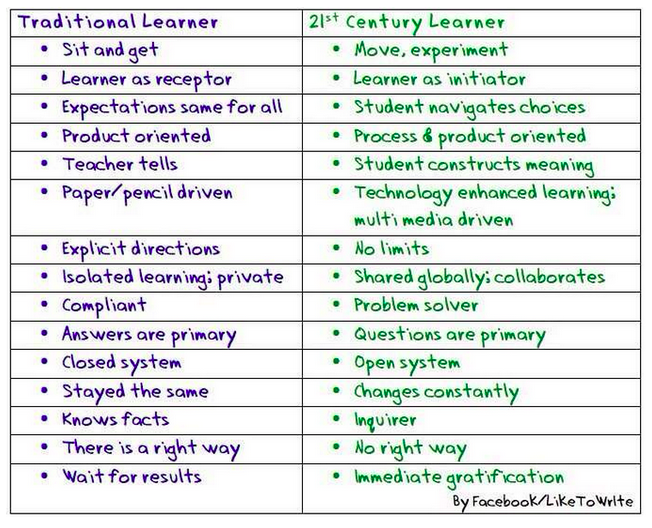
What Does Learning Look Like?

 
This chart is created by Like to Write 
In the pursuit of designing learning and what it could possibly look like, I am forced to re-visit the multitude of readings about learning in the 21st Century. I have previously articulated my reticence of these texts as we are too far into this century to pull the 'time to change' card. It should have changed in my books by now.

We know and have now known for a longtime that the world is changing rapidly and that we cannot begin to predict what the world will look like in 8 years let alone 50. Collectively, it sounds as though everyone involved in education acknowledges that we are preparing all children to be active participants in a globally, connected world. But it seems that some view the 3Rs as the old band aid that needs to be ripped off quickly and cleanly while others see them as the enablers that must be central to early learning. 

The key competencies refer to real skills such as growing as critical thinkers, goal setting  and knowing what to do when the going gets tough. Managing themselves to get through those hard places so that they can achieve well by picking themselves back up and carrying on. Surely, these competencies are not 'extra' things to cover in the learning environments? Each of the key competencies is evident in the process of learning and it is this that needs to be the focus in our habitats not the content. 

The devices are a perfect vehicle for facilitating the learning process. This suggestion is not to be confused with creating another stand alone curriculum that involves learning how to use the technology. Nor is it about teaching with technology tools. Instead, it is about the children creating and constructing with the technology. 

Knowledge is accessible and totally ubiquitous and this alone has placed a greater emphasis on the need to shift our practices. Children don't need to think of things, but need to think about them. This takes us to a whole new level of thinking including analysis, synthesis and evaluation. 

We need to develop the children's communication skills so that they are able to communicate in our media rich world.  They need to be able to use their learning to solve problems and to record this digitally including texts such as news broadcasts, gaming, blog reflections. The engagement that these tools provide give licence to the children to create texts that reflect their individuality. 

The use of platforms such as google docs allows for collaboration. It is important to note that collaboration is not just about helping each other or giving each other feedback. Truly collaborative tasks will enhance student learning by closely modelling how they are likely to work as adults. 

We need to be aware of our role in helping children to understand the process of learning and the grit needed to achieve longterm goals/ projects. We need to ensure that learning is authentic and meaningful for the children. 

9 May 2015

Moon Shot Thinking


Moonshot Thinking is a way of thinking. Courage, persistence and growth mindset are crucial. Choose to be bothered by things because they are hard. Our ambitions can be a glass ceiling on our passions. 

Have the courage to try!
We choose to do this because it is hard!
We are a species of moon shots!
Take risks, inspire others.

It's okay to not know how to do it yet!

7 May 2015

We Had a Feeling

It's hard to believe that is was nearly 5 years ago that the classes I was working with did this project in a dance colaboration. It was a magical moment when the kids were able to connect via skype with classrooms around NZ and the world to share/ perform a dance. The product was the end of year dance item. The wonderment and awe was the connecting, the collaborating and developing an understanding of the Arts and how our culture impacts on us.


Here's what it looked like from Mr Miller's end...


SuperScooper Dance Instruction from John Miller on Vimeo.

This is Mr Wood's Class - Room 17 from Bailey Intermediate practising...

2 May 2015

Lester Flockton discusses what is needed to connect the School Curriculum with the intent and changed emphases ofThe New Zealand Curriculum. 


We need to develop a structure that embraces the nature of learning, values, essential components that develop self directed, motivated and engaged learners who are empowered throughout the learning process. 

Mark Treadwell describes personalised learning as:  
- making sure we know our audience and purpose
- knowing why we are learning our learning intention
- applying efficient and effective ways to learn
- being engaged in the learning process 
- knowing what knowledge is needed to build the required understanding

Mark also explains Conceptual Curriculum as a paradigm shift from text based learning systems to multimedia and collaborative environments. Concepts are built from a body of knowledge and requires numerous contexts. Understanding concepts is a developmental process, as your braining is constantly developing. 

We have conceptual understandings in our Curriculum Document =

The four conceptual strands in the social sciences curriculum are: 
• Identity, Culture, and Organisation; 
• Place and Environment; 
• Continuity and Change; 
• The Economic World. 

The four conceptual strands in the health and physical education curriculum are: 
Hauora
Attitudes and values
Socio- ecological perspective
Health promotion

So why use a Conceptual Curriculum?

-When learning concepts we use different parts of the brain to create a better understanding; neurons (7% neurons used for rote learning), using concepts for learning uses astrocytes (75% of brain cells and neurons)
-Keeps learning authentic and purposeful for the student
-In an information age concepts allow us to organise information in our own way in a meaningful structure
-Allows flexibility for teaching and learning
-Student focused


Sir Ken Robinson challenges us to move away from conformity, standardisation and 
the production line mentality. It's necessary to change the paradigm and begin 
to address divergent thinking. 

22 April 2015

Partnerships, Pathways, Learning Conversations...


Partners' where Michael Fullan identifies a 'tension' in education that is going to 
eventuate in change. He refers to bored students, alienated teachers and the 
'exploding, irresistible and alluring digital world' that grabs the imagination of 
children. Re-reading all of this I am reminded that there is actually a real public 
acceptance that education is on the precipice of 21st Century learning.

Fullan suggested in his report written late 2013, that change is inevitable and 
eminent. He also suggested that the change, when it comes, will be based on: 
deep learning goals, new pedagogies, and technology.

That suggestion resonates with me. My TAI a few years ago culminated 20 
years of teaching inquiries including flexible learning spaces, 20% time, 
student-led learning and it is only recently that the pieces have all begun to fit 
together. I don't think I have ever worked so hard as I worked in that year but 
the outcome was genuine self-directed, engaged learners with a sense of agency 
and ownership of their learning. It was hard and my inquiry still continues to 
be iterative and based on outcomes on learning. But the outcomes show that 
change in my practice had an impact so they are worthwhile to pursue and re-think.

As school systems try to manage this change, Fullan suggests that there is only 
one obvious possibility for schools and that is to revisit  pedagogy, and redefine 
how they operate. Fullan suggests four key strategies:

i)  Irresistibly engage both students and teachers (I believe whanau need to be 

included here)
ii)  Ensure technologies are efficient and easy to use (Maybe BYOB/D is not the 
best option in primary?)
iii)  Make technology ubiquitous (To be ubiquitous, access is paramount: we need 
to know what access our children have from home and perhaps BYOB/D will 
become instrumental to this)
iv)  Ensure learning is rooted in real-life problem solving and inquiry (Meaningful 
learning experiences/ relevant inquiry/ local curriculum)

Fullan suggests that schools  will clearly need significant restructuring to ensure those 

four strategies are able to be utilised to promote deep, purposeful learning.  My own 
inquiry has investigated (and continues to investigate) how I, as the teacher, can best 
work with my students as learning partners, reflecting the concept of Ako - everyone
is a learner, everyone is a teacher.